

“Who can figure out where we are?” asks river guide John DeMary of the 40-odd high school students surrounding him. He hands out maps of the Chesapeake Bay watershed showing ancient landmarks like the Potomac and Shenandoah Rivers along with more modern features like Washington DC and Baltimore. “When you think you know where we are on the map, bring it back.”
Where are we indeed? The most obvious answer is on the shore of the Shenandoah River, not far from where it joins the Potomac at Harpers Ferry WV and surrenders its identity as a separate river for the remainder of its journey to the Bay. We’re standing in the great Commonwealth of Virginia at the moment, having traveled to this spot in a flotilla of canoes, but we can easily see the houses across the water on the West Virginia side. I’m here as part of my work with The Downstream Project – a nonprofit organization that works with conservation partners to promote stewardship through visual arts and technology – as they explore a partnership with River and Trail Outfitters, the company leading the day’s trip. We launched about an hour ago under overcast skies on this early May day and now, in groups of six or seven, students lean over their maps on the gravelly shore searching for signs of their surroundings.
John makes the rounds to each group. A retired high school science teacher, he now leads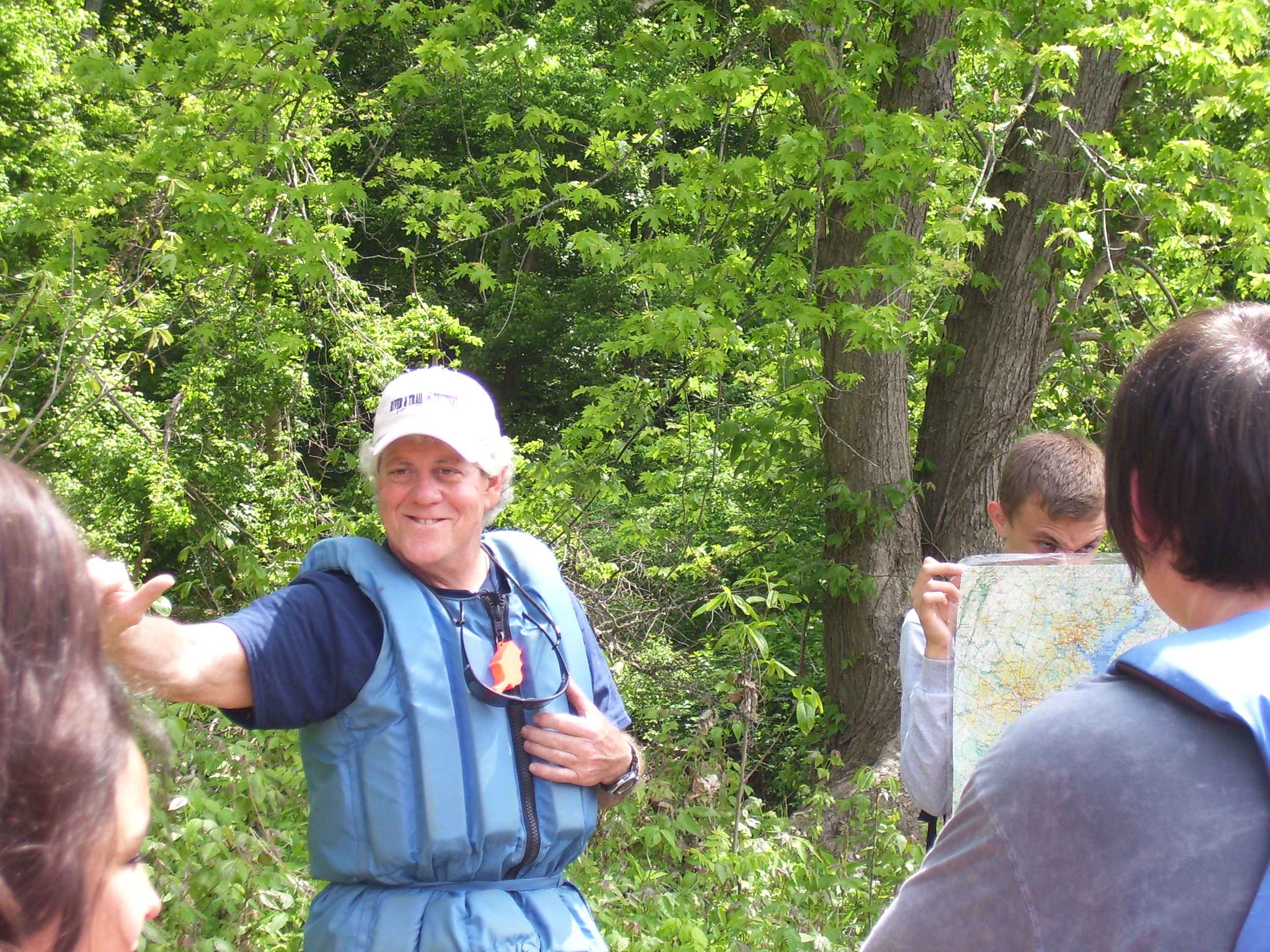
The students from Briar Woods High School in Ashburn VA are well prepared by teacher Patricia Blackwell. They understand that riparian buffers of vegetation can absorb polluted runoff. They’re familiar with the dangers of pesticides. Some of them can even identify a great blue heron when it flies upstream. They’re middle class kids from a good high school in suburban DC. And yet, as one of the school’s chaperones tells me later, some of these kids have never been out here before. “They go to the Outer Banks {for vacation in North Carolina} and see people kayaking, and they wouldn’t even think about doing it themselves.”


And so John and Mike make sure these kids do. At the next stop, John unwraps two seine nets and recruits a bunch of guys to overturn rocks in the river and see what macroinvertebrates – a.k.a large creepy crawlies – get swept into the nets. He’s looking for bioindicators of water quality and wants the students to use the laminated field guides to identify what species are living in this part of the river. Soon each net has a crowd of students around it trying to see what they’ve caught, generating a few squeals and shouts in the process. Some species are very sensitive to water quality and can only live in very clean waters. Others are less picky and tend to dominate in degraded conditions. The presence of mayflies, caddisflies and waterpennies in the nets reveals that this stretch of the Shenandoah is in pretty good shape according to John. Good news for today. Meanwhile, Mike has pulled a chewed up stick out of the water. “What ate this bark?” he asks the crowd. Beaver is the right answer. More good news.

By the time we pull into the takeout at Shannondale in West Virginia, the sun has finally broken through the overcast sky. Those whose novice canoe skills led to inadvertent dunkings earlier in the day now skillfully maneuver onto shore, and dry out in the warm sun. Having grown up canoeing on the Delaware River and in Adirondack lakes with my father, I was a little nervous as we started out that morning surrounded by a large pack of newbies. But I wasn’t going to say no to a chance to get on the river and I believe wholeheartedly in John and Mike’s mission. They want these kids to have a life changing experience and take with them a commitment to be better environmental stewards for the rest of their lives. As the students pile onto the bus at the end of the day it’s too soon to say if that’s the case. But if their paddling skills are any indication, it’s clear that the best way of learning is by doing. And perhaps in the process of learning, some of them will even find their place.
