


Which really drives home (pun intended) the need to revisit those ideas. We understandably got side-tracked from simplicity in the post-World War II boom. After all, that war was a testament to new technology. High tech saved our neck, and in the euphoria of the post-war years our parents and grandparents embraced it. Better living through chemistry, a new ranch home in Levittown for everyone and a big convertible to go with it. In the process, millions of people made millions of dollars in the fossil fuel, construction, and appliance industries, stimulating widespread wealth and a thriving middle class.
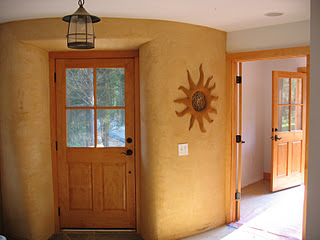
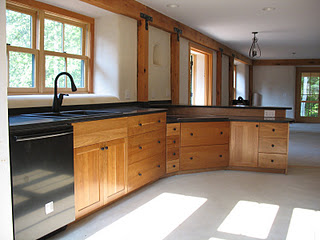
Okay, it worked. For a while. But as we enter 2012 we seem trapped in a model developed in the 1950’s. The only wolf at the straw house door now is convention: We’ve built and heated homes the same way for so long, it’s hard to break out of the mold, despite what we now know about the environmental and national security risks of fossil fuel fixation. Jeff and Kristin had to work closely with their designer and builder (who was new to most of the green technology they embraced) to create a comfortable home while maximizing the alternative (and mostly simple) options available for reducing its footprint. They also had to educate county staff as they applied for permits to accommodate their unusual utility systems. None of this is rocket science, but somehow we all need to relearn it.
Or maybe it is rocket science. The most profound (and wealth-generating) technological advances in recent decades have been digital. Computers can now do the stuff of science fiction (talking mobile phones anyone?) and the most promising future break from convention might very well be the smart grid. The best description I’ve read of this is in Thomas Friedman’s 2008 book Hot, Flat and Crowded. He compares our current electric utility systems to an all you can eat buffet: power companies offer an endless supply of electricity 24/7 for a cheap flat rate. Consumers take as much as they want, whenever they want and power companies (as required by law) have to ensure that they have the capacity to meet that demand at any time. That means they have to build new plants just to meet peak demand, like on those really hot summer days when everyone runs the air conditioning nonstop, or winter evenings when everyone comes home from work and turns on the lights, the dishwasher and the washing machine at the same time. But on a smart grid, consumers can program their use based on time of day, rate or even source. If they want to use power at peak times, they pay a peak rate. If they would rather pay a lower rate, they program their dishwasher to run at 3 a.m. A smart grid could power down appliances when the load (and price) peaks, or when people are away from home, thus smoothing out the peaks and valleys of energy use. It could distinguish among energy sources, supplying (and charging for) renewable energy sources for those who request it, rather than charging everyone a flat rate regardless of whether they get their Fuels from Heaven or Fuels from Hell (as Friedman puts it). Much of this technology exists today. The challenge is establishing the incentives and infrastructure to implement it.
Yes, a challenge. But it does kind of make you go “duh.”